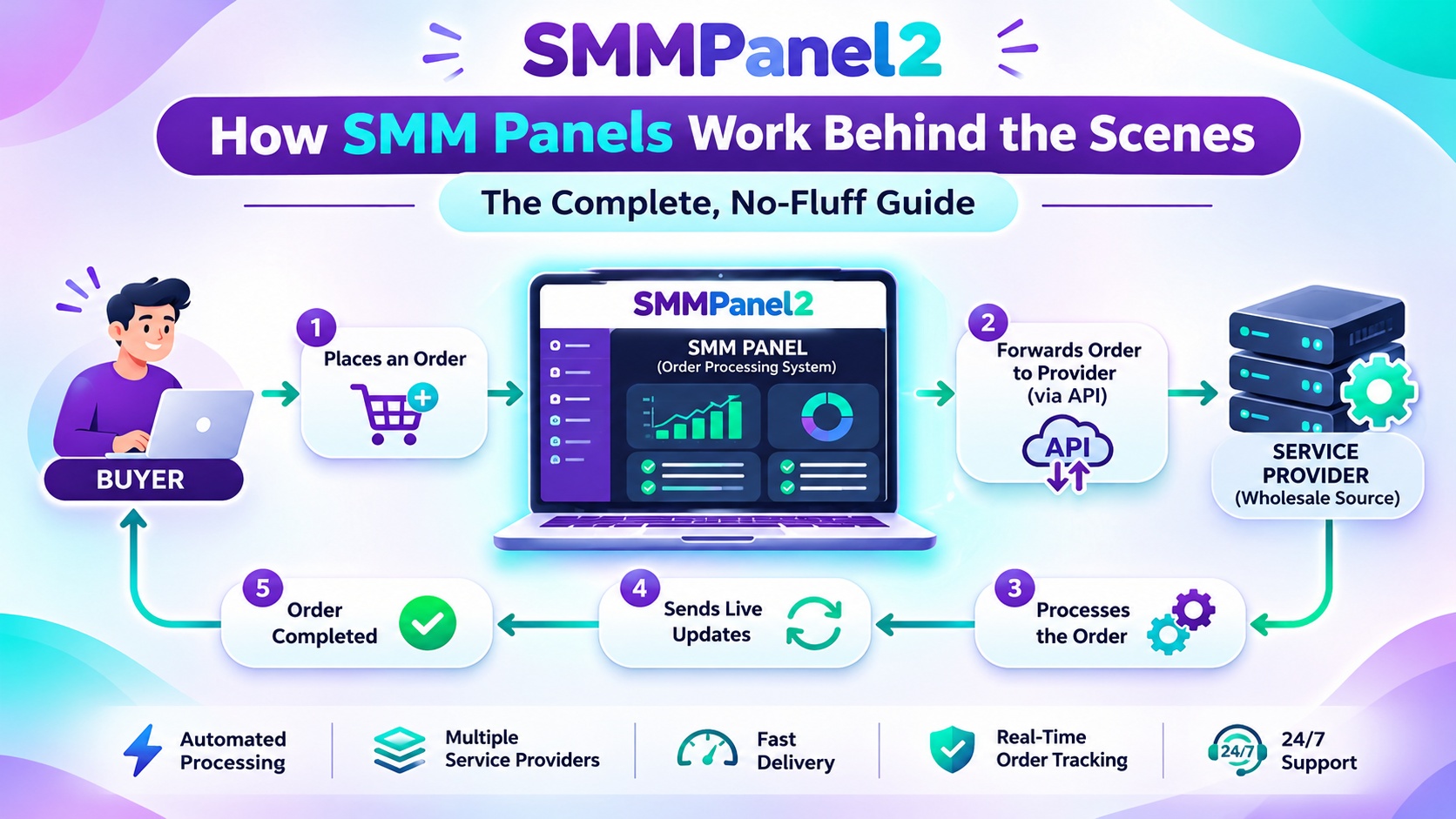
How SMM Panels Work Behind the Scenes – Complete Guide
An SMM panel is an online platform that allows users to explore and order social media marketing services through a centralized dashboard. But what happens after someone selects a service, enters a social media link and places an order? Behind the interface, several processes may work together, including order validation, API integration, service provider connections, payment management and order tracking. Understanding how SMM panels work behind the scenes helps digital marketing agencies, freelancers, resellers and businesses make better decisions when choosing a platform.
In this guide, we explain the complete SMM panel working process, from customer order placement to backend processing, with examples relevant to businesses in India and international markets.
What Is an SMM Panel and What Does It Actually Do?
An SMM panel, also known as a Social Media Marketing panel, is an online platform that brings different social media-related services together in one place. Users can browse available services, check prices, submit order details, manage account balances and monitor order statuses through a dashboard.
Depending on the platform, services may cover social networks such as:
YouTube
Instagram
Facebook
Telegram
Other supported social media platforms
For example, a digital marketing agency managing multiple client projects may use a centralized panel to organize service orders instead of handling every request through separate conversations with different providers.
An SMM panel generally acts as an ordering and management interface. It may connect directly with service providers or use third-party API integrations to process orders.
SMM Panel vs Social Media Marketing Agency
These two business models are not the same.
SMM Panel
Social Media Marketing Agency
Provides an online ordering dashboard
Provides marketing strategy and campaign management
Users select services from a catalogue
Services are often customized for clients
Orders may be processed through provider integrations
Work may involve in-house teams, advertising tools and contractors
Pricing is generally displayed per service
Pricing may depend on project scope and management fees
Requires users to understand service requirements
Agencies often guide clients through the marketing process
An SMM panel can be one component of an agency's workflow, but it does not replace a complete digital marketing strategy.
How SMM Panels Work Behind the Scenes
The SMM panel working process involves several connected steps. The exact technical setup differs between platforms, but a typical order management workflow can be understood through the following stages.
Step 1: Customer Registration and Dashboard Access
The process usually begins when a customer creates an account on an SMM panel.
After registration, the user may get access to a dashboard containing:
Available social media services
Service descriptions and pricing
Account balance or wallet information
Order placement forms
Order history and status
Support or help options
The dashboard acts as the main interface between the customer and the panel's order management system.
For example, an agency in Delhi may log in to manage service requests for its clients, while a freelancer in another country may use a similar dashboard for their own workflow.
Step 2: Service Selection and Order Placement
After accessing the dashboard, the user selects a service from the available catalogue.
A typical order form may request:
The service selected by the customer.
The social media profile, post, video or channel link.
The requested quantity, where applicable.
Any additional information required by that service.
The user should read the service description carefully before submitting an order. Different services can have different requirements, restrictions and delivery conditions.
Step 3: Order Validation and Balance Deduction
Once an order is submitted, the panel's system may validate the information before processing it.
Validation can include checking:
Whether the selected service is available.
Whether the submitted link follows the required format.
Whether the requested quantity meets service limits.
Whether the customer has sufficient account balance.
Whether the order meets applicable service conditions.
If the information is accepted, the system may create an order record and deduct the applicable amount from the user's wallet.
If a required detail is missing or invalid, the order may be rejected or remain unprocessed until the issue is resolved.
Step 4: Order Forwarding to a Service Provider
This is where the backend process becomes more technical.
Some SMM panels connect with external service providers. When a customer places an order, the panel may forward the order details to the relevant provider through an API integration.
The information transferred may include:
Service identifier
Target social media link
Requested quantity
Internal order reference
Other service-specific parameters
The provider's system may then accept the request and return a response containing an external order reference or processing status.
Not every SMM panel uses the same architecture. Some may manage certain services internally, while others depend on third-party providers.
Step 5: Service Processing and Delivery Updates
After an order reaches a provider, its processing depends on the provider's system, service conditions and availability.
The provider may return updates such as:
Pending
Processing
In progress
Completed
Partial
Cancelled
Failed
The SMM panel can use these responses to update the customer's order history.
It is important to understand that an order being accepted does not necessarily mean that it has been completed. Processing times and outcomes can vary, and a panel should communicate service limitations clearly.
Step 6: Order Completion and Record Management
When the provider reports a final status, the panel may update the order record.
Depending on the platform's implementation, the system can store information such as:
Customer order ID
Selected service
Submitted link
Requested quantity
Amount charged
Current order status
Provider reference
Submission and completion timestamps
This information helps customers review their order history and helps support teams investigate issues.
How SMM Panel API Integration Works
An API, or Application Programming Interface, allows two software systems to communicate with each other.
In the SMM panel industry, API integration can connect a panel's dashboard with an external service provider's system. Instead of manually forwarding every order, supported systems can exchange order information electronically.
What Is an SMM Panel API?
An SMM panel API is an interface that allows compatible systems to perform supported actions, such as submitting orders, retrieving service lists and checking order statuses.
A typical API-based workflow looks like this:
A customer submits an order through the panel.
The panel validates the order.
The panel sends a request to the provider's API.
The provider receives and processes the request.
The provider returns an order reference or response.
The panel stores the reference and checks for status updates.
The customer sees the latest available status in the dashboard.
Common API Parameters
Depending on the provider's API documentation, an order request may contain parameters such as:
Parameter
Purpose
Service ID
Identifies the selected service
Link
Specifies the target social media URL
Quantity
Indicates the requested amount
Order ID
Identifies an order within a system
Status
Communicates the current processing state
The exact parameter names and request formats vary between API providers.
Direct Orders vs API-Based Reseller Orders
A direct order is submitted through the panel's own interface and may be processed by its internal system or an integrated provider.
An API-based reseller order involves one platform sending the order to another compatible platform or provider.
For example, a reseller may operate a customer-facing dashboard while using an external provider's API to process supported requests. The reseller platform manages its own customer accounts, pricing and order records, while the provider handles the connected service.
API integration can reduce manual work, but it also introduces dependencies. If an external API becomes unavailable, order submission or status synchronization may be affected.
Who Provides the Services Behind an SMM Panel?
An SMM panel does not necessarily produce every service displayed in its catalogue. Some platforms work with external service providers, while others may have their own infrastructure for selected services.
Direct Providers
A direct provider supplies services to a panel without another reseller platform acting as an intermediary in that particular transaction.
The actual relationship depends on the business arrangement and technical integration.
Third-Party Suppliers
A panel may connect with another platform that sources services from additional providers. This creates a supply chain in which the customer-facing panel may not directly control every part of the processing system.
Why Service Quality and Availability Can Vary
Different services may have different providers, processing methods and operational limitations.
Availability and outcomes can be affected by:
Provider system availability
API connectivity
Platform changes
Service-specific requirements
Provider capacity
Social media platform enforcement and policy changes
For this reason, users should not assume that every service in a panel follows the same process or offers identical conditions.
How Payments, Wallets and Pricing Work in SMM Panels
Most SMM panels provide an account balance or wallet system through which customers pay for orders.
Adding Funds to an SMM Panel Wallet
A typical payment workflow may include:
The customer selects an available payment method.
The customer enters the amount they want to add.
The payment gateway processes the transaction.
The panel receives a payment response or confirmation.
The account balance is updated according to the panel's payment process.
Available payment methods vary by platform and region. Indian customers may see payment options designed for local transactions, while international customers may have access to other supported payment methods.
How SMM Panel Pricing Works
The displayed price can depend on several factors:
Provider pricing
Service type
Minimum and maximum order quantity
Platform and service requirements
Operational costs
Reseller margins
Payment processing costs
A reseller may set a customer-facing price above the provider's purchase price. The difference can represent the reseller's gross margin before other expenses.
However, the lowest displayed price should not automatically be treated as the best option. Clear service descriptions, transparent terms, support and realistic expectations are equally important.
Refunds and Failed Transactions
Payment and refund processes vary by platform.
A customer should check whether the panel explains how it handles failed deposits, duplicate payments, cancelled orders and eligible refunds.
Read the SMMPanel2 Refund Policy before placing an order so you understand the applicable terms.
How SMM Panel Order Tracking and Delivery Status Work
Order tracking is an important part of an SMM panel dashboard. It allows customers to see the latest status available from the panel or connected provider.
Common SMM Panel Order Statuses
Order status
General meaning
Pending
The order has been submitted but processing may not have started
Processing
The system is handling the order request
In Progress
The provider has started processing the order
Completed
The provider has reported the order as completed
Partial
The order has been completed only in part
Cancelled
The order has been cancelled
Failed
The order could not be processed successfully
The precise meaning of each status should be confirmed through the individual panel's documentation.
What Are Start Count, Delivered Quantity and Remains?
Some panels display additional order information.
Start count: The recorded starting value when the service begins, where supported.
Quantity: The amount requested by the customer.
Delivered quantity: The amount reported as delivered or processed.
Remains: The quantity still outstanding, where applicable.
These fields are useful for reviewing order progress, but their availability and calculation methods depend on the panel and provider.
Why Do SMM Panel Orders Sometimes Get Delayed?
Orders may remain pending or take longer than expected because of provider delays, API connectivity problems, incorrect links, service restrictions or system maintenance.
If an order is delayed, customers should first check the service description, submitted link and current status.
For more information, read:
What Happens to Customer Data and Order Information?
An SMM panel may process different categories of information to operate its dashboard and order management system.
This can include:
Account registration details
Login credentials
Order links and service selections
Payment transaction references
Account balance records
API credentials for authorized integrations
Customer support conversations
Why Account Security Matters
Customers should follow basic security practices when using any online marketing platform.
Use a strong, unique password.
Do not share account login details unnecessarily.
Never disclose payment OTPs or banking passwords.
Keep API keys private.
Use only authorized integrations.
Review the platform's privacy policy and data handling terms.
A service that requests a social media account password should be treated with caution. Users should understand exactly what access is being requested and why before sharing any credentials.
How SMM Panels Support Agencies, Freelancers and Resellers
SMM panels are used by different types of digital marketing professionals. Their role can vary depending on the business model and the services being offered.
Digital Marketing Agencies
An agency may use a panel as one part of its internal service management workflow. A centralized dashboard can help organize orders and review their statuses.
For example, an agency in India managing clients in multiple countries may use an online system to organize service requests across different projects.
However, an agency should still provide clients with an appropriate marketing strategy, campaign reporting and transparent communication.
Freelancers
Freelancers may use panels to manage service requests for individual projects. The dashboard can help them track submitted orders and review their account activity.
SMM Panel Resellers
A reseller may operate a customer-facing panel while connecting to an external provider through an API.
A simplified reseller workflow is:
Create and manage a customer-facing platform.
Configure supported services.
Connect compatible provider APIs.
Set customer-facing prices.
Receive and validate customer orders.
Forward supported orders to providers.
Monitor statuses and manage customer support.
The reseller remains responsible for communicating service terms, pricing, refund conditions and limitations to customers.
India-Based Agencies Serving International Clients
An agency based in India can work with clients in different countries through online dashboards, remote communication and digital payment systems.
For international operations, agencies should consider:
Supported payment methods and currencies
Time-zone differences
Customer support availability
Clear service descriptions
Applicable local business and data protection requirements
Platform-specific policies in each market
An online SMM panel can make order management more centralized, but it does not automatically provide international marketing strategy or market-specific campaign expertise.
Are SMM Panels Safe and How Do Social Media Platform Policies Apply?
Safety depends on the platform's practices, transparency, data handling, service providers and the type of service being purchased.
One important consideration is the difference between legitimate social media promotion and artificial engagement.
Legitimate Advertising vs Artificial Engagement
Legitimate advertising uses approved advertising systems and campaign tools to reach audiences according to platform rules.
Artificial engagement involves manipulating metrics through inauthentic activity, such as fake views, likes, subscribers or followers.
Social media platforms can remove artificial engagement and take action against accounts or content that violate their policies.
For example, YouTube's Fake Engagement Policy prohibits artificially increasing views, likes, comments, subscribers and other engagement metrics. Artificial engagement should not be treated as a legitimate way to meet monetization requirements.
Businesses should prioritize genuine audience development, valuable content, approved advertising methods and policy-compliant promotion.
Before using any service, review the relevant platform's current rules rather than assuming that a service is permitted simply because it appears in an online catalogue.
SMM Panel vs Direct Social Media Advertising: What's the Difference?
Both SMM panels and direct social media advertising are used in the broader social media marketing ecosystem, but they operate differently.
Comparison
SMM Panel
Direct Social Media Advertising
Main interface
Third-party ordering dashboard
Official advertising platform
Order process
Service selection and order submission
Campaign setup and approval
Audience targeting
Depends on the service and provider
Campaign targeting options are available
Budget management
Depends on panel pricing and wallet system
Advertiser sets campaign budgets
Reporting
Usually order-based tracking
Campaign and performance analytics
Platform control
Depends on the panel and provider
Uses the platform's official advertising infrastructure
Best suited for
Managing supported service orders
Running structured advertising campaigns
For businesses seeking measurable customer acquisition, audience targeting and campaign optimization, official advertising tools are generally the more appropriate route.
An SMM panel should not be considered a substitute for a complete advertising strategy.
How to Choose an SMM Panel for Your Business
Choosing an SMM panel requires more than comparing service prices. Agencies, freelancers and resellers should evaluate the platform's operational transparency and support.
Consider the following checklist:
1. Transparent Service Descriptions
Check whether the platform explains service requirements, limitations, supported links and applicable conditions.
2. Clear Pricing
Review minimum quantities, displayed rates, payment terms and any additional charges.
3. API Documentation
If you are a reseller or developer, check whether the platform provides API documentation and explains its supported operations.
4. Order Tracking
Look for an understandable order history with clear status information.
5. Customer Support
Check how customers can contact support and whether the platform explains its process for resolving order issues.
6. Refund and Cancellation Terms
Understand the rules for failed orders, partial orders, cancelled requests and eligible refunds before depositing funds.
7. Privacy and Security
Review the platform's privacy information, account security practices and approach to API credentials.
8. Realistic Expectations
Avoid platforms that promise guaranteed viral results, permanent engagement, monetization approval or guaranteed social media growth.
A reliable decision should be based on transparent information and a clear understanding of service limitations.
How SMMPanel2 Fits into the SMM Panel Workflow
SMMPanel2 is an online SMM panel platform where users can explore social media-related service categories and review available ordering options through its website.
Users can begin by exploring the SMMPanel2 and reviewing the available service information.
Depending on their requirements, users can also explore dedicated service categories:
YouTube SMM Panel for YouTube-related service options.
Instagram SMM Panel for Instagram-related service options.
Facebook SMM Panel in India for Facebook-related service options.
Telegram SMM Panel for Telegram-related service options.
Users who are new to the concept can also read the SMM Panel working guide to understand the basic ordering process.
Before selecting any service, review its description, requirements, pricing and applicable conditions. Always follow the relevant social media platform's policies and avoid treating artificial engagement as a substitute for genuine audience development.
Frequently Asked Questions
Q1. How do SMM panels work behind the scenes?
SMM panels generally use an online dashboard and an order management system to process customer requests. Depending on the platform, orders may be validated, forwarded to connected service providers through APIs and tracked through status updates. The exact backend architecture differs between panels.
Q2. What happens after placing an order on an SMM panel?
After an order is submitted, the panel may validate the selected service, target link, quantity and available balance. If accepted, the order is recorded and may be forwarded to a connected provider. The panel can then display status updates as processing continues.
Q3. What is an SMM panel API?
An SMM panel API is a software interface that allows a panel to communicate with another compatible system. It can support actions such as submitting orders, retrieving service information and checking order statuses, depending on the API documentation.
Q4. How do SMM panels connect with service providers?
Some panels use API integrations to send order details to external providers. These details may include a service identifier, target link and requested quantity. The provider can return an order reference or processing response to the panel.
Q5. Why do SMM panel orders sometimes remain pending?
Orders may remain pending because of provider delays, API connectivity issues, incorrect links, service restrictions or maintenance. Customers should check the submitted information, review the service conditions and contact support if the status does not change.
Q6. How do SMM panel wallets and payments work?
Many panels use a wallet system. Customers add funds through supported payment methods, and the panel updates their balance after receiving the applicable transaction confirmation. Order charges are then deducted according to the platform's pricing and payment process.
Q7. Can digital marketing agencies use SMM panels for multiple clients?
Agencies may use SMM panels to organize supported service orders across different projects. However, they should maintain clear client communication, track orders carefully and ensure that their marketing activities follow the relevant social media platform policies.
Q8. What is the difference between an SMM panel and an SMM reseller?
An SMM panel is the online ordering platform. An SMM reseller is a person or business that sells services to customers, sometimes using another provider's API. A reseller may operate their own customer-facing panel while relying on external providers for processing.
Q9. Are SMM panels safe to use?
Safety depends on the panel's security, transparency, service providers and data handling practices. Users should protect login details, avoid sharing unnecessary account credentials, review refund policies and understand whether the services comply with the relevant social media platform rules.
Q10. Can SMM panels work with international customers?
Online panels can serve customers across different countries when their registration, payment and service systems support those markets. International users should check payment availability, currency support, service conditions, time zones and applicable local requirements.
Q11. Do SMM panels guarantee social media engagement?
No general guarantee should be assumed. Service availability, processing and results depend on the specific service, provider and platform conditions
About the Author
Shevam – SEO & Digital Marketing Expert
Shevam has over 10 years of experience in SEO and digital marketing. His expertise includes search visibility, digital growth strategies and online marketing platforms.
Through SMMPanel2, he shares information about social media marketing services, platform features and digital growth strategies.
Read more about the author on the SMMPanel2 Author Profile.